
Trumbull Sources for Past Residents
The backward trail begins with the record that can carry the address farthest back, then adds sources that describe people rather than title. Trumbull's modern RecordHub service has a login gate and does not state its searchable backfile date on the observed page. The catalog and microfilm record gives an older land-record route. Telephone books are periodic, permits have a local cutoff, and census pages stop at a historical release boundary.
| Source | Years | Where Held | What It Shows |
|---|---|---|---|
| Trumbull land records and index | 1798 to 1911 catalog; index to 1910 | Town Clerk, State Library, FamilySearch, CTGenWeb | Grantor, grantee, deed, mortgage, release, book/page |
| RecordHub | Current service; local backfile unstated | Cott RecordHub / Town Clerk | Online search and image route, with account or office fallback |
| Vision card and sales history | Current card; sample rows 2022 to 2025 | Vision Government Solutions | Owner field, parcel, values, sale pointer, building and land |
| Permits and street cards | Current or post-2013; cards before Dec. 31, 2013 | Municipal Searches / Building | Addressed work history and older street-card clues |
| Telephone directories | 1930, 1933-35, 1940-45, 1955-56, 1961/62 | Library of Congress and local repositories | Listed subscriber, business, address, exchange, classification |
| Church, cemetery, vital, probate | Runs vary; probate index 2011 to present | State Library, churches, DPH, Probate District 46 | Family, death, burial, estate, and place clues |
| Federal census | Historical sequence through 1950 | National Archives and genealogy repositories | Household at a census date, not continuous current occupancy |
Use a source for what it actually records. A deed transfers title, a directory lists a subscriber, a census counts a household at one date, and a probate file can name a fiduciary or heir. The previous residents of a house emerge from the overlap.
Trumbull Land Records Back to 1798
Historic Trumbull land records are cataloged from 1798 to 1911, with a general index through 1910 and microfilm notes reaching about 1900. The CTGenWeb Trumbull index and the FamilySearch catalog are finding aids, not a promise of open images. The Town Clerk remains the local title-search route. RecordHub is the current online service, but the research capture showed only email, password, account, help, and policy controls. No live grantor-grantee result or deed image was captured without the portal session.
For an older address, search both modern Trumbull and the place terms inherited from Stratford or North Stratford. Connecticut's county government ended in 1960, so Fairfield County is a geographic label, not a current recorder archive. Older probate may also use Stratford or Bridgeport district records.
- Grantor
- The person or entity transferring an interest in the recorded instrument.
- Grantee
- The person or entity receiving the interest in that instrument.
- Chain of title
- A sequence of recorded transfers linking a later owner back through earlier instruments.
- Legal description
- The deed or recorded-map description that controls the parcel, beyond a postal street label.
Tracing Trumbull Owners Backward
Take the current owner-of-record and sale pointer as the first lead. A Vision card can show a current owner field, PID, MBLU, ACT NUMBER, sale date, sale price, Book & Page, and ownership-history row. The pointer is not the deed image. Move into RecordHub or the Town Clerk counter, then read the recorded instrument and legal description before searching earlier parties.
- Save the exact address, PID, MBLU, ACT number, valuation year, owner field, Book & Page, and sale date from Vision.
- Use the book/page or name route at RecordHub, or ask the Town Clerk for the title-search counter and certified-copy procedure.
- Read grantor, grantee, recording date, instrument type, legal description, map reference, and consideration if printed.
- Search the new grantee as an earlier grantor, then repeat with the prior transfer while preserving every date and identifier.
- Compare the legal description and map to the current parcel before treating two address labels as one property.
Documents received on or after July 1, 2025 have a listed recording fee of $70 for the first page and $5 for each additional page, with other charges possible. Confirm the current fee with the Clerk. A title chain identifies recorded transfers, not all people who lived in the building.
Trumbull Permits Across Time
Municipal Search supplies a second address trail. Current or post-2013 permit requests use an online Veoci workflow or PDF. The form asks for requester name and email, exact address, residential or commercial property type, permit record numbers, comments, and a commercial-search acknowledgment. The response or status is emailed.
Pre-December 31, 2013 street cards are a separate file arranged alphabetically by street, plus Main Street. Ask for both periods when tracing a renovation or change in use. The Town FAQ says the Building Department may hold major-addition or deck records, and a plot plan is not always held by the Clerk. A permit can date work; it is not title proof.
| Address clue | Custodian question |
|---|---|
| Current or post-2013 permit | Use Municipal Searches and state the exact address and date range. |
| Older street card | Ask for the alphabetized pre-Dec. 31, 2013 card file. |
| Major addition or deck | Ask whether Building, rather than the Clerk, holds the material. |
| Subdivision map | Ask the Clerk whether a recorded map exists; do not assume a plot plan is there. |
Trumbull Directory-Era Households
The Library of Congress has regional telephone directories for 1930, 1933 to 1935, 1940 to 1942, 1943 to 1945 classified material, 1955, 1956, and 1961/62. Search the Trumbull locality index, then surname and initials. Preserve a listed address, exchange, number, occupation, business heading, page, and book date. The books show listed subscribers, not all household members.
The Trumbull Library can provide non-circulating local-history access, inspection, and copying, but its official page does not confirm a reverse or criss-cross run. The Trumbull city directory archive explains how to read these editions. If an old street name or locality conflicts with a modern address, compare the parcel map, deed description, and historic place term.
Woods Estate Trumbull Ownership Story
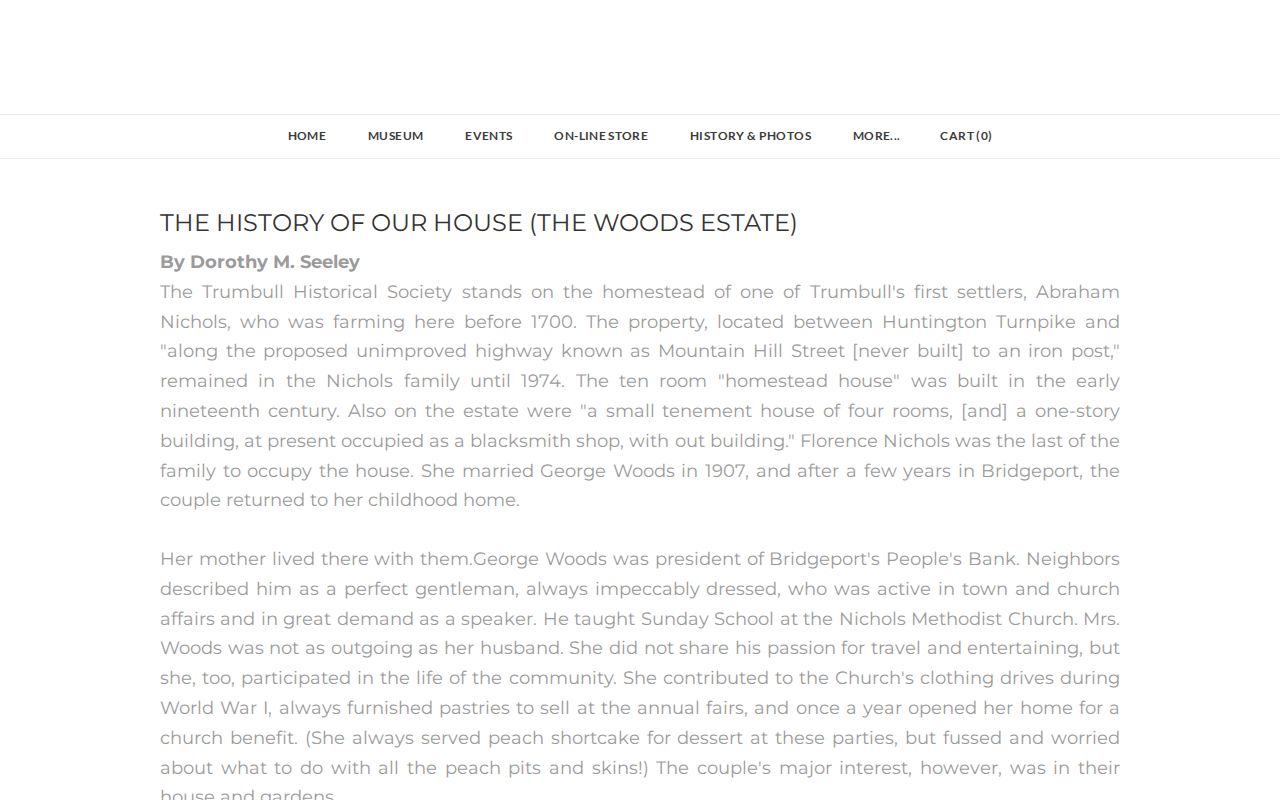
The Woods Estate gives a documented example of a property timeline. The Historical Society traces the place from the Nichols family through George and Florence Woods, to Nichols Methodist Church, then to Town acquisition in 1974 and a Historical Society lease in 1978. The story is about a property and its institutions. It does not identify a current private resident.
For a different named house, use the same layered method: current Vision card, Town Clerk instrument, permit or street card, historical directory, church or cemetery record, probate, and library or Historical Society context. Mark each line as title, occupancy clue, family clue, or institutional history.
The Society's house-history source is here:
A well-labeled property history is more useful than an unsupported claim that a person lived there.
Trumbull Church and Cemetery Clues
Church and burial sources can close a previous residents trail when a directory ends. The State Library guide identifies Christ Church Tashua, Church of Christ, Grace Church, and an early births, baptisms, and marriages transcript. Hale's Fairfield material identifies nine Trumbull cemeteries, and the town historical-resource entry describes Christ Episcopal Church and Tashua Burial Ground from 1766.
No official municipal interment lookup or Trumbull obituary index was confirmed. Search the library, State Library, Historical Society, Connecticut Digital Archive, church, and cemetery routes by surname and date. An inscription, transcription, obituary, death certificate, and probate case each have different weight and access rules.
Pairing Trumbull Sources by Era
Past residents are easier to separate from one another when records are placed on a small timeline. Directory years are snapshots. Census years are household snapshots. Deeds mark transfers. Permits mark work. Vital and probate records can explain why a household changed. Record the source date beside every name.
| Clue | Pair it with | Reason |
|---|---|---|
| 1930 or 1940s telephone entry | Another directory year, census, church, or deed | Tests continuity of name, address, and locality. |
| 1955 or 1961/62 subscriber | Vision parcel and recorded map | Bridges a regional telephone address to a current parcel. |
| Historic owner in a deed | Probate, death, cemetery, or obituary | Explains an estate or transfer endpoint. |
| Permit or street card | Assessor building section or map | Separates construction history from title history. |
The most recent generally public federal census is 1950 under the 72-year release rule. Use it as historical household evidence, never as a current resident directory.
A practical timeline should also mark the source's kind of relationship to the address. A deed may show title, a permit may show work, a directory may show a subscriber, and a probate file may show an estate connection. If two names occur in the same year, keep both until a legal description, family record, or separate dated source explains the difference. This prevents a familiar surname from becoming an unsupported household link.
Limits on Trumbull Previous Residents
The research file found no official Trumbull street-renumbering or renaming project with a year, no Trumbull-specific Sanborn volume, and no formal town house-history guide. The Sanborn search guide explains how to read coverage, while the 1913 Bridgeport regional item is not a Trumbull-specific map. A missing address match may reflect a changed label, a regional directory locality, an unlisted subscriber, or a gap in the repository. Do not fill that gap with a guessed conversion.
Use the Town Clerk, library, Historical Society, State Library, FamilySearch, church, cemetery, probate, or court route that fits the evidence. A previous residents search is for lawful personal history, genealogy, estate research, and property curiosity. Respect protected addresses and stop when the record is withheld for safety.
Lawful use. A house-history trail may identify recorded owners or dated subscribers, but it is not permission to stalk, harass, intimidate, or harm a person connected to an address.